This weekend was a lunar perigee full moon. These don’t happen all that much together; perigee is the moon’s closest point to Earth in its orbit so the net result is an ever so slightly larger and therefore brighter moon. I decided to take advantage of this situation by driving to Joshua Tree National Park, a roughly 3 hour trek. I left the house around 12:30 PM and arrived at the Visitor’s Center at the northern edge of the park at 3:00 PM. A quick discussion with a ranger, a purchased entrance fee and off I went into the park. I drove on Geology Tour Rd and Queen Valley Rd (both unimproved) before deciding on hanging out along a stretch of Geology Tour Rd. The ranger assured me that area would very dark and pretty much devoid of people.
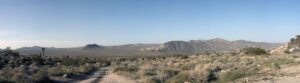
I stopped at the very southern corner of Geology Tour Rd and shot this panorama looking north of Pleasant Valley.
Setting Up and Weather
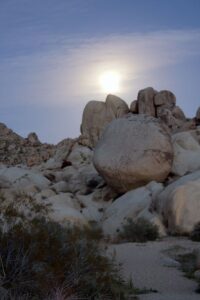
I found a good turn-off next to the road and set up. The moon rose above the rock formations and I took this image.
The full moon is behind a cloud. This was an ominous beginning; the clouds were coming in from the coast in front of the rain storm that hit us the next day. The clouds cut down the light available and made exposure estimation that much harder.
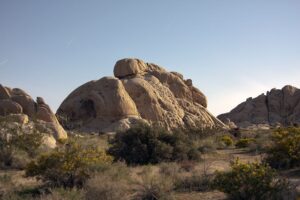
This was a multiple-minute exposure of a granite rock outcropping just off the road.
Eventually the clouds became so heavy I had to abandon the activity; the light was less than half what it was at the beginning of the evening.
Lessons learned:
1. Bring extra batteries. I went through a double battery pack in 3 hours of shooting. The long exposures really drain the batteries.
2. Next time I’ll get a hotel room out there and work all night instead of feeling like I had to get done by a certain time so I could safely drive home.
3. Give more time for location scouting.
4. Improve my autofocus management technique.
Beware the Ides of March – The Assassination of Julius Caesar
The Day
March 15, 44 BC (the Ides of March in the Roman calendar) was a bad day for Julius Caesar. He was murdered by a group of 40 Roman Senators (including a Senator he considered an ally, Marcus Brutus to whom as Shakespear famously wrote he said “Et tu, Brute?” (You, too, Brutus?) as Brutus approached him to stab him) as he was walking to the Roman Senate building in the Roman Forum. The place he was murdered was a meeting room in the back of a structure called Pompey’s Theater. He was later cremated in the Roman Forum after a eulogy given by his friend Marc Antony, who said “I come not to bury Caesar, but to praise him.”
He was murdered because he had recently been declared “Permanent Dictator,” thus threatening the existence of the Roman Republic. This was in response to his military victories in Gaul after which he returned to Rome, crossed the Rubicon River with his personal army – an illegal act – and declared “The die is cast” (or maybe more likely “Let the dice fly”) as he did it.
Important Sites in Rome
The Rubicon
The Rubicon’s original location is now lost (a river in the Emilia Romagna region, 300+ km north of Rome was determined to be the Rubicon in 1991). This river as with many in the Po Valley, underwent a great deal of civil engineering over the centuries and so its original natural flow has been erased.
The other places – the Roman Senate building, the site where he was cremated, the site where his eulogy was given, Pompey’s Theater and the meeting room where he was assassinated – all still exist and can be visited in various ways.
Pompey’s Theater
Largo di Torre Argentina
Pompey’s Theater was a permanent stone theater in Rome. Pompey was a powerful Senator who skirted the rules forbidding permanent theater structures by putting a small temple on the top and a few meeting rooms in the back and calling it a temple and convention center. It exists today south of Piazza Navona as a series of centuries old apartment buildings built upon the theater superstructure; you can follow the semi-circular curve of the building.
You can also have a meal in a restaurant called Ostaria Costanza thereby sitting inside the support structure with the original brickwork and archways.
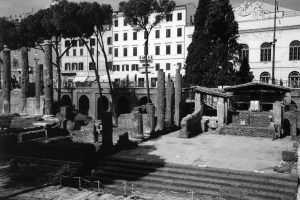
The meeting room where Julius Caesar met his demise is at the eastern end of the complex. You can see it if you visit the excavated temple complex of the Largo di Torre Argentina. The room remnants can be seen by standing in the right location on the eastern side and looking west. The area is a cat sanctuary and the room is now, believe it or not, a lavatory. In the photo above, the room in which Caesar was murdered is past the archways visible in the near background below street level. What survives of Pompey’s Theater is beyond and behind those large-ish buildings in the background.
The Roman Forum
The Roman Forum includes a rebuilt-restored Senate building and a small ruined temple room with altar that is the claimed site of his cremation. The spot where the eulogy was given is called the Rostra. The Rostra was the site for giving important speeches to the Senate building and to people gathered in the Forum’s open square.
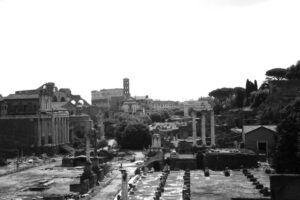
His cremation site can be seen in the photo above but just barely; locate the well-preserved Temple of Antoninus and Faustina on the far left of the photo. Follow the front stairs down to the dark gray “lump.” That lump is the ruins of the memorial and cremation platform. The Rostra is not visible but it is beyond the lower left part of the frame.
Consequences
The result of Julius Caesar’s assassination was a years long civil war between Marc Antony and Caesar’s nephew Octavian. It resulted in the defeat of Marc Antony’s army and the death of Cleopatra and Marc Antony via snake bite. Octavian became Augustus and was the first emperor of the Roman Empire. He was also the guy who commanded the Biblical Slaughter of the Innocents census that caused Joseph and a pregnant Mary to return to Bethlehem.
The Roman Calendar – Calends, Nones and Ides
Wikipedia has a great explanation of the numerous calendars Romans used during the course of their time on Earth, but basically the Romans described only particular points during the month with a title. The calends was the beginning, the nones was somewhere around the 5 to 7th days and the ides was usually the 13th but in March and a few other months it was the 15th. These points are generally thought to be based on moon phases (Calends = new moon, Nones = half moon, Ides = full moon). Other days were represented by “days after calends” or days before nones.” It seems that the Romans’ calendar is, like their numbering system, a lot more complicated than it needs to be.
So, from this one incident on the Ides of March more than 2 000 years ago we get several common sayings (“Et tu, Brutus!” for betrayal, “Crossing the Rubicon” for an act that can’t be taken back) and even once in a while someone will substitute a well regarded individual’s name for Caesar in the famous eulogy. We can still visit the places at which these events occurred.
Cookie Consent
We use cookies to improve your experience on our site. By using our site, you consent to cookies.
Used to monitor number of Google Analytics server requests
10 minutes
__utma
ID used to identify users and sessions
2 years after last activity
_ga
ID used to identify users
2 years
_gac_
Contains information related to marketing campaigns of the user. These are shared with Google AdWords / Google Ads when the Google Ads and Google Analytics accounts are linked together.
90 days
_ga_
ID used to identify users
2 years
_gat
Used to monitor number of Google Analytics server requests when using Google Tag Manager
1 minute
_gali
Used by Google Analytics to determine which links on a page are being clicked
30 seconds
_gid
ID used to identify users for 24 hours after last activity
24 hours
__utmx
Used to determine whether a user is included in an A / B or Multivariate test.
18 months
__utmz
Contains information about the traffic source or campaign that directed user to the website. The cookie is set when the GA.js javascript is loaded and updated when data is sent to the Google Anaytics server
6 months after last activity
__utmv
Contains custom information set by the web developer via the _setCustomVar method in Google Analytics. This cookie is updated every time new data is sent to the Google Analytics server.
2 years after last activity
__utmc
Used only with old Urchin versions of Google Analytics and not with GA.js. Was used to distinguish between new sessions and visits at the end of a session.
End of session (browser)
__utmb
Used to distinguish new sessions and visits. This cookie is set when the GA.js javascript library is loaded and there is no existing __utmb cookie. The cookie is updated every time data is sent to the Google Analytics server.
30 minutes after last activity
You can find more information in our Cookie Policy and .
 Setting Up and Weather